Show Notes
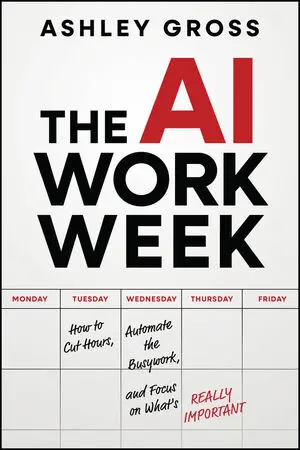
Featured Book
The AI Workweek
How to Cut Hours, Automate the Busywork, and Focus on What's Really Important
By Ashley Gross · Wiley
Get the bookShe didn't get maternity leave. So she rewired the entire way she worked, and accidentally redrew the map of what her career was worth.
Funding stage: Bootstrapped. Ashley built AI Workforce Alliance incrementally out of a 9-to-5, grew it on the back of a free newsletter and a Maven waitlist, and explicitly said she did not want to "raise funds and be stressed out about it." Upper six-figure revenue, no outside capital, growth funded by partnerships. That is textbook bootstrapped.
In 2020, Ashley Gross was just another marketer pulling 80 hours inside a 40-hour job, operating on the oldest visibility hack in the book: be the first one in, be the last one out. Then she became a mom with no leave on the table, and the math stopped working. So she started teaching AI to do her busywork, not to impress anyone, but to claw back time with her newborn.
What happened next is the real story. The automation didn't free her. It exposed her. All the work she clawed back came flooding right back in, because she was the comfort person, the human Google, the one who knew where every document lived. Knowledgeable, indispensable, and quietly underpaid. That gap, between the work you do and the work people can see, became her whole thesis.
She walked into the CMO's office, handed over her playbook, and built her own unpaid internal AI champion role to test one question: does this knowledge transfer to other humans? Within three months, the answer was a $25 million pipeline overachievement. That was the moment the imposter syndrome died. Then came the newsletter, zero to over 5,000 in two months of cringey, daily, ego-at-the-door posting. Then a Maven waitlist of more than a thousand people telling her they would pay. Only then did she jump, never risking the paycheck that fed her family until the runway was already built.
Today AI Workforce Alliance runs on a team of twelve full-timers, ten-plus part-timers, freelancers, and a few agents quietly handling the admin in between. Notion is the centralized brain. Claude and MCP connectors do the talking. The tech stack went from sprawling to five tools. The plan for 2026 is to 10X through partnerships. And she still hates social media, which is exactly why you should trust her when she says you have to do it anyway.
Named Frameworks From the Conversation
The Visibility Tax
Ashley's core thesis: pay tracks visible value, not hours logged.
- →You are not paid for your work. You are paid for the work people can see.
- →Most people work far more than they communicate about that work, then feel insulted by the number the market hands back.
- →Leadership is influence, and influence is communication. Doing the work is not enough if nobody can see the value.
- →The fix is to automate the busywork so you have time to communicate the value.
Tasks, Not Titles
Your portable, repriceable value lives in the tasks you ran, not the title you held.
- →Your title describes one lane, one ladder, one company. Your actual five-year task list describes your real, portable, repriceable skill set.
- →People who fuse their identity to a title get destroyed when the org reorganizes.
- →Audit the systems and tasks you actually ran, not the words on the business card.
Crawl, Walk, Run Exit
De-risk the leap by proving the income before you quit.
- →Keep the 9-to-5. Build the proof on the side. Jump only when the income is already there.
- →Always know your exit, even if you never take it. The plan reveals which milestones to hit and when.
- →She started planning her exit the day she learned there was no maternity leave.
Interrogate Before You Automate
Automation's real first payoff is forcing you to examine the process at all.
- →You cannot automate a process you have never examined. The act of automating forces you to ask 'is there a better way,' a question almost nobody stops to ask.
- →A workflow run only inside one human's head is already the riskiest version. If they leave tomorrow, the process leaves with them.
- →An 80% automated workflow that is occasionally wrong beats a 100% human one that is reliably slow, as long as you keep the high-risk, must-not-hallucinate steps separate.
The 5, 10, 15 Plan
Rolling long-range plans plus weekly reviews keep work and family aligned.
- →She runs her life, family, and business on rolling five, ten, and fifteen-year plans, with quarterly goals and weekly 'business meetings' for the household.
- →Grass grows where you water it. Intentional planning is why she reports zero guilt about the work-versus-family pull.
Founder Experiment You Can Run This Week
Pull up your last five years and write down the actual tasks and the actual systems you used to do them, ignoring your title completely. Then circle every task that is repeatable busywork. Pick the single most annoying one, document the steps a human currently keeps only in their head, and automate it with one tool. Use the time you reclaim not to do more work, but to communicate the value of work you have already done. That last step is the one everyone skips, and it is the one that gets you repriced.
Key Terms from This Episode
Outcome-based pay
Compensation tied to the result delivered, not hours logged.
Go-to-market engineer
A newer role applying AI and automation to traditional go-to-market work. Same job description as a GTM pro, plus the tooling.
AI consultant
Advisor who helps organizations design and deploy AI into real workflows. A title that did not exist five years ago.
AI champion
An internal owner who pilots and spreads AI practices across teams.
LLM
Large language model, the technology behind tools like Claude and ChatGPT.
MCP (Model Context Protocol)
A standard that lets AI tools connect to and exchange data with apps like Notion.
Deterministic vs. probabilistic work
Tasks that must be exactly right every time (medical, materials) versus tasks where occasional error is tolerable. The skill is separating the two.
Run rate
Annualized revenue based on current performance.
Revenue per employee
Total revenue divided by headcount, a quick read on efficiency.
ICP
Ideal customer profile, the exact buyer you are built to serve.
Q&A: What Founders Ask After This Episode
How do I get paid for outcomes instead of hours?
Build visibility around the value you deliver, automate the busywork that hides it, and communicate results so the market reprices you instead of guessing.
Will AI take my job?
The pattern Ashley describes is jobs shifting, not vanishing. New roles like go-to-market engineer and AI consultant appear, often paying more for the same base skills plus tooling.
How do I leave my job to start a business without going broke?
Crawl, walk, run. Validate demand with an audience and a waitlist while still employed, then jump once income is proven.
What should I automate first with AI?
Internal productivity workflows, because the riskiest version already lives undocumented inside one person's head.
Should I automate a process that is only 80% reliable?
Yes for low-risk internal work. Keep high-risk steps that cannot tolerate hallucination separate and human-checked.
How do I grow a newsletter from zero?
Post daily, publish weekly, leave your ego at the door, and earn trust over months. There is no shortcut, only consistency.
Tools from This Episode
AI Workforce Alliance
Ashley Gross's company helping teams and professionals move from hours-for-dollars to outcome-based work by changing how they actually use AI. Runs on a lean five-tool stack with Notion as the centralized brain and Claude plus MCP connectors doing the talking.
Five Founder Questions This Episode Answers
- →How do I price myself on the value I create instead of the hours I burn?
- →Where do I actually start with AI so it gives me time back instead of becoming the eleventh tool I never open?
- →How do I build a business on the side without ever risking the paycheck my family depends on?
- →How do I introduce AI to a team that thinks it is coming for their jobs?
- →How do I plan my work and family so I stop feeling pulled apart by both?
URLs Mentioned in the Episode
- AI Workforce Alliancehttps://aiworkforcealliance.com
- Ashley Gross on LinkedInhttps://www.linkedin.com/in/theashleygross
- The AI Work Week (Wiley) — Barnes & Noblehttps://www.barnesandnoble.com
- The Gathering Place, Denverhttps://tgpdenver.org
- AI for Foundershttps://aiforfounders.co