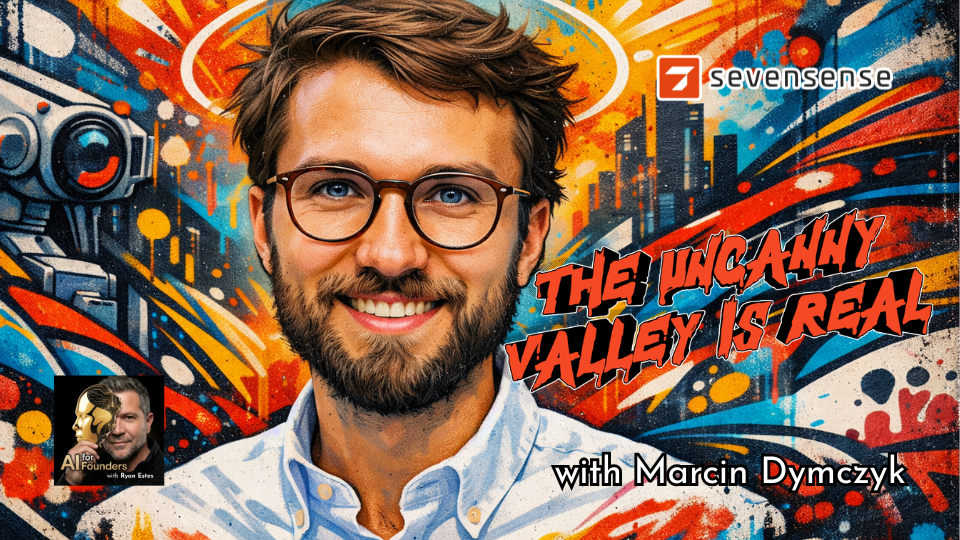
The uncanny valley is real
The uncanny valley is real
Show Notes
Ryan opens with a founder gut check. Scale sounds sexy, but control is the real addiction. Then Marcin walks in with a real world mirror, because warehouses do not care about your pitch deck, and robots do not care about your assumptions.
Sevensense builds the “eyes and brains” for mobile robots, not the whole robot. The story starts in the ETH Zurich ecosystem where robotics talent is dense, labor is expensive, and the only way to win is to build high-value systems that actually work outside the lab. Marcin explains how early industrial robots were basically obedient roombas with a job title, rigid paths, brittle behavior, and zero ability to handle a changing environment.
Then the thesis lands. Vision-based navigation uses natural features, so you do not need QR codes on the floor, magnetic tape, or a warehouse redesigned around your machine. Instead, you give a robot something closer to human perception, cameras, inertial sensing, wheel and leg signals, and enough compute to reason about space. The result is not just navigation. It is adaptability.
The conversation expands into the social layer. Robots need to communicate intent so humans trust them. Lights, sounds, turn signals, speed indicators. And robots need to understand humans as humans, not as just another obstacle. Predict motion. Yield. Negotiate the sidewalk dance. The future of robotics is not only engineering. It is manners.
Marcin’s founder journey is a deep tech reality check. Early money gets wasted on cool R&D nobody needs. The breakthrough comes from a gritty commercial project, autonomous cleaning machines that forced them to ship systems that worked for non-roboticists, with real customers and real consequences. That pain becomes the advantage. Robustness becomes the moat.
https://www.linkedin.com/in/dymczyk/
https://www.linkedin.com/in/estesryan/